Sending money to Ghana? What the Bank of Ghana's new remittance rules mean for you
The Bank of Ghana's updated guidelines put a 24-hour payout clock on providers, anchor the exchange rate to a daily Bloomberg reference and ban hidden rebates. Here is what changes when you send money home.
By Ernest · 12 October 2026
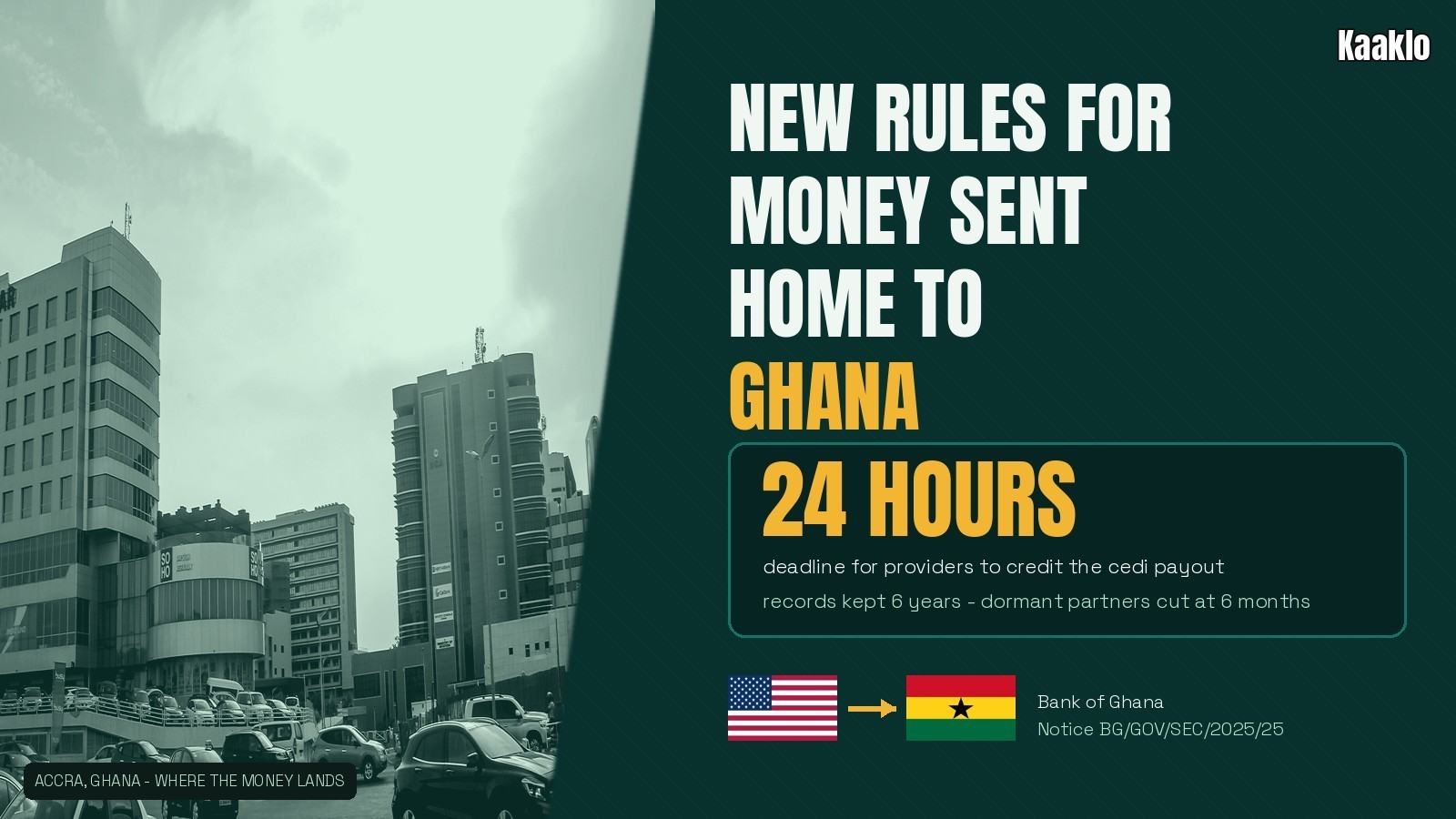
On 25 August 2025 the Bank of Ghana published Notice No. BG/GOV/SEC/2025/25, its updated guidelines for inward remittance services by payment service providers. [1] These are the rules for the companies that deliver your transfer in Ghana: the mobile money issuers and larger payment firms that partner with the money transfer operators behind the apps on your phone. If you send money to Ghana, this framework sits behind every payout.
The numbers that matter
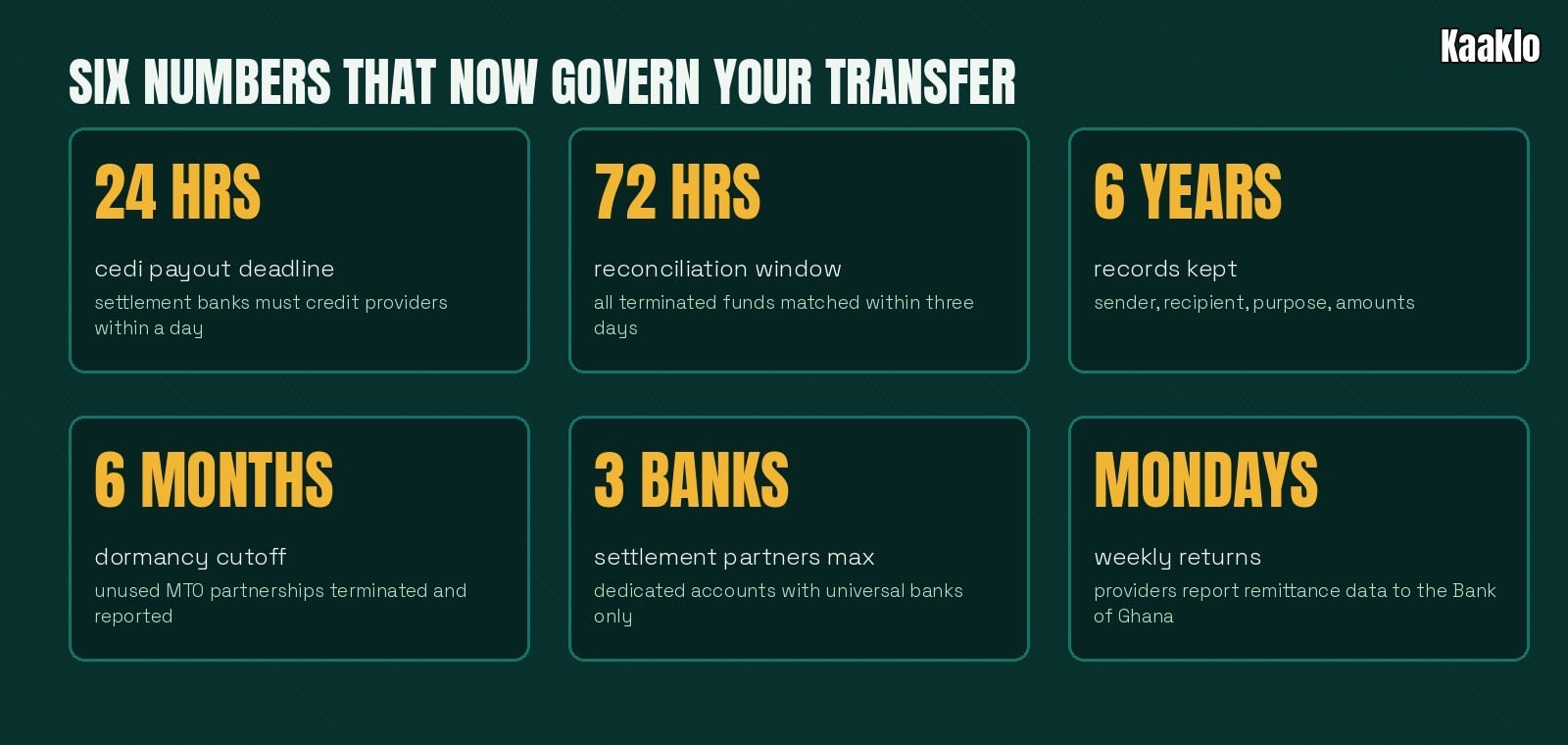
Settlement banks must credit the provider's cedi settlement account within 24 hours, and all terminated funds must be reconciled and matched within 72 hours. Providers must keep full transaction records for at least six years: sender and recipient names, contact numbers, country of origin, purpose of transfer, and the amounts in foreign currency and in cedis. A partnership with a money transfer operator that sees no transactions for six straight months must be terminated and reported to the Bank. Each provider may use at most three partner banks, and data returns go to the central bank every Monday. [1]
The exchange rate rule
The settlement bank must convert settlement funds into cedis on the same day, at the Average Opening Bloomberg USDGHS Regional (REGN) bid-ask range, or the corresponding currency pair rate range on the day the transfer is received. [1] In plain terms, the rate is anchored to a published daily reference, not invented at the payout desk.
What changed from the 2023 version
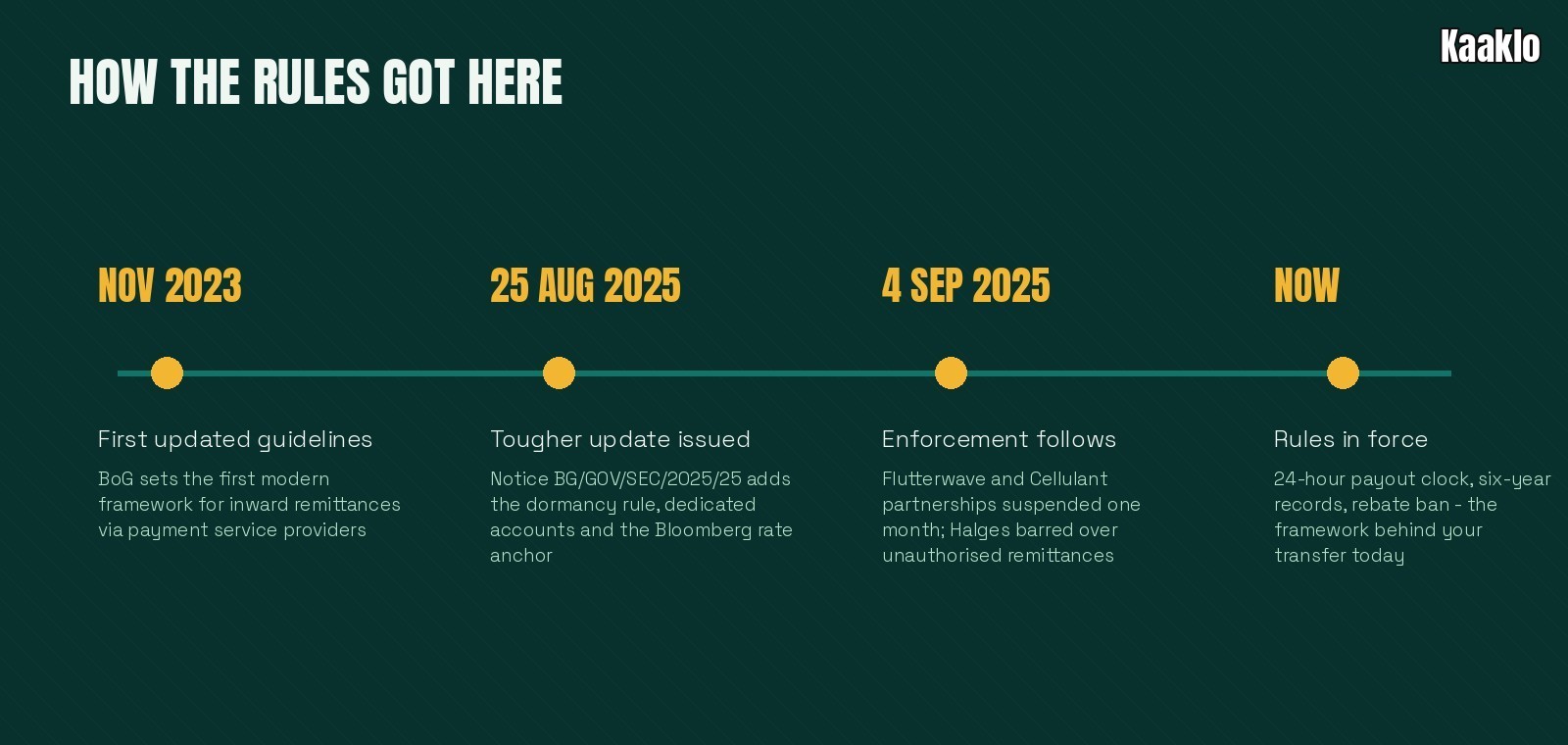
The 2025 update adds a "dormant partner rule": providers must review their money transfer partnerships, and any that have gone six months without a transaction must be ended and reported. [1] Remittance money must sit in a dedicated settlement account with a universal bank, kept operationally separate from every other account, and the online vendor accounts used to fund payouts must be dedicated to remittances only. Providers may not misreport remittance inflows as peer-to-peer transactions. And rebates, commissions or preferential arrangements that distort the market are explicitly banned. [1]
How the rules got here
The enforcement backdrop
Days after the update, on 4 September 2025, the Bank of Ghana suspended the remittance partnerships of Flutterwave Inc. and Cellulant Ghana Limited for one month and barred Halges Financial Technologies Limited, saying they had conducted unauthorised remittance activity on behalf of money transfer operators including Top Connect, Send App, Taptap Send, Remit Choice and Afriex, through their settlement bank, United Bank for Africa Ghana Limited. [2][3] The point for senders: the rules have teeth, and the Bank is watching the whole chain, not just the app you see.
What changes for you as a sender
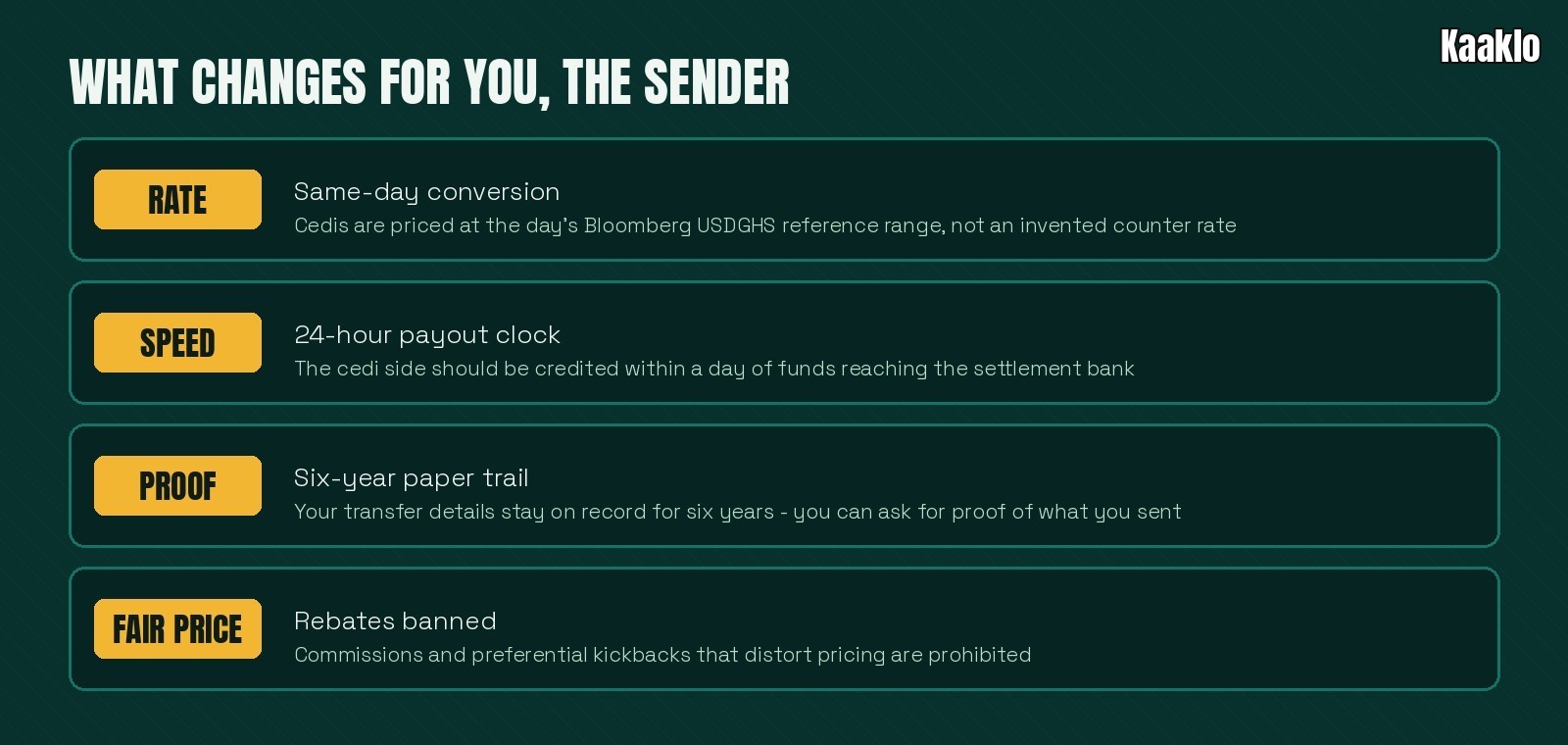
The rules bind the providers, not you. But they explain why your app asks for the purpose of each transfer and for your recipient's details, and they set the standards you can hold the service to when something goes wrong.
What to do now
Use licensed providers. Compare the cedi amount your recipient will actually get, not just the advertised fee. Keep your receipts and transaction references. If a payout stalls, escalate first through the provider's own complaints channel, then through the Bank of Ghana's consumer recourse mechanism, which the guidelines require providers to follow. [1]
Sources and data note
Prepared 12 October 2026. Checked against the Bank of Ghana's own notice and press release. The guidelines date from August 2025 and remain the framework in force; nothing here is financial advice.
[1] Bank of Ghana, Notice No. BG/GOV/SEC/2025/25, 25 August 2025