Shipping a car to Ghana: the duty maths nobody shows you
Import duty is only the start. How Ghana actually prices your car at Tema, what a clearing agent can and cannot do, and the traps that cost people thousands.
By Ernest · 9 October 2026
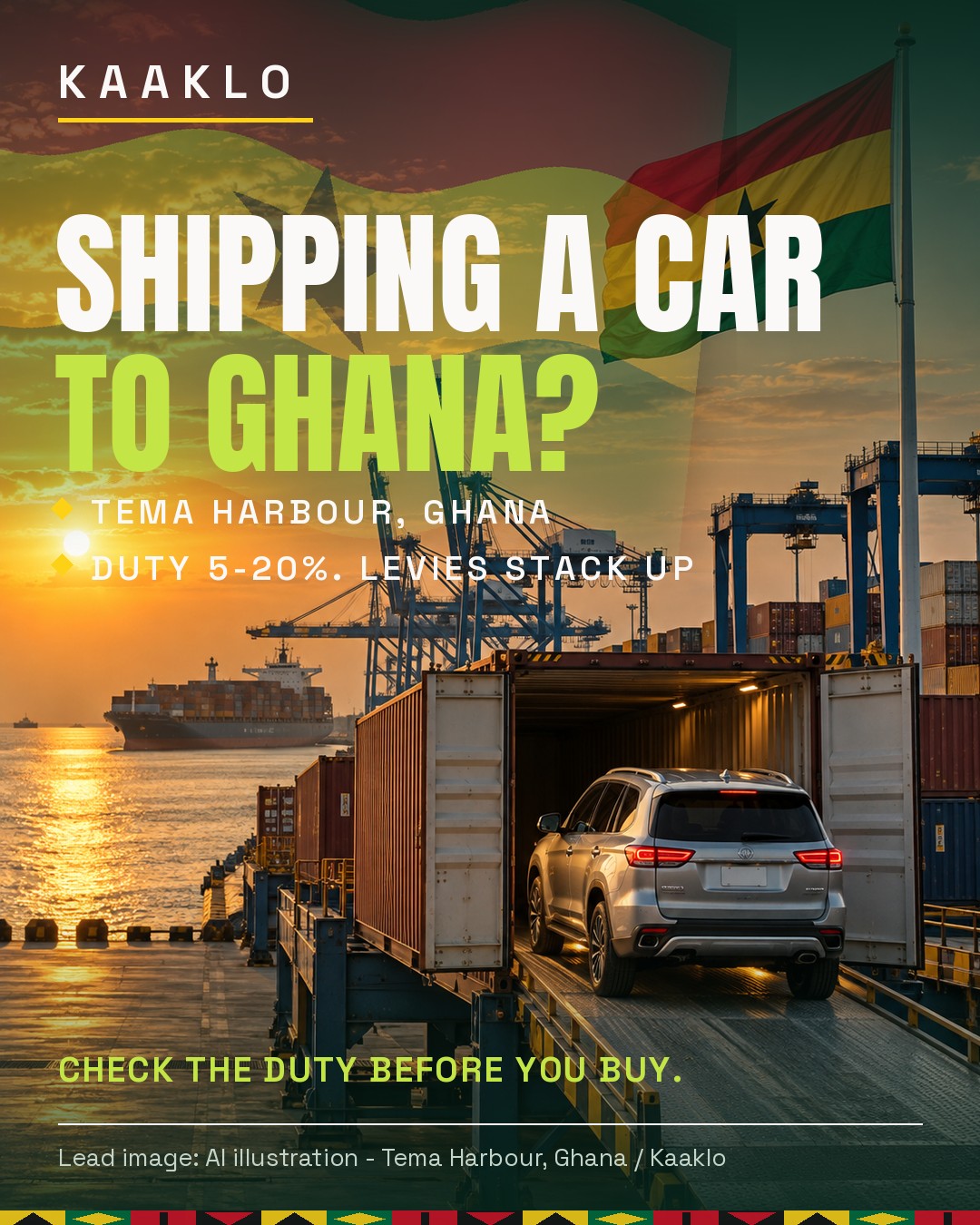
A car bought for £4,000 in the UK can land at Tema and pick up close to its own price again in charges before it drives out of the port. People who have shipped before know this. People shipping for the first time usually find out from a WhatsApp message from their clearing agent, when the car is already on the water and the bargaining position is gone.
The charges themselves are not secret. The Ghana Revenue Authority publishes the full structure, and you can check the likely duty on a specific car before you buy it. This guide walks through how the number is really built. [1]
How Ghana prices your car
The first surprise: the duty is not based on what you paid. Customs starts from the manufacturer's original price when the car was new, applies a depreciation of between 0 and 50 per cent depending on the car's age, and that gives the Free On Board value. The current exchange rate is applied, then freight and insurance are added to reach the CIF value - cost, insurance and freight. Every charge that follows is a percentage of that CIF figure, or of a value built on it. [1]
This is why a car that was cheap on a UK listing can carry a bigger customs value than expected, and why arguing about the purchase price at the port goes nowhere.
The charge stack
Import duty depends on fuel type and engine size. For petrol cars it is 5 per cent up to 1,000cc, 10 per cent from 1,000 to 3,000cc, and 20 per cent above 3,000cc. Diesel cars pay 5 per cent up to 1,500cc, 10 per cent up to 2,500cc, and 20 per cent above that. Then the levies arrive, each with its own base: [1]
| Charge | Rate |
|---|---|
| Import duty (petrol 1,000-3,000cc) | 10% of CIF |
| VAT | 12.5% of CIF + duty + NHIL + GETFund |
| NHIL (health insurance levy) | 2.5% of CIF |
| GETFund levy | 2.5% of CIF |
| African Union levy | 0.2% of CIF |
| ECOWAS levy | 0.5% of CIF |
| EXIM levy | 0.75% of CIF |
| Examination fee (used vehicles) | 1% of CIF |
| Special import levy | 2% of CIF |
On an illustrative CIF of GH₵100,000 for a 2.0-litre petrol car, this stack comes to roughly GH₵34,000 - about a third of the customs value - before port handling, storage and the agent's own fee. Your figure will differ: the CIF depends on the car, and only the customs system can produce the real number. [1]
The ten-year question
Cars older than ten years attract an additional overage penalty, also calculated on the CIF value, with limited exceptions such as agricultural tractors, ambulances and hearses. If the car you are eyeing is an older bargain, price the penalty in before you fall for it: an old car with a low sticker can end up costing more to clear than a newer one. [1]
Check the duty before you buy
This is the step that changes everything, and it is free. Ghana's customs system, ICUMS, can show the likely duty on a specific vehicle from its chassis number (VIN), make, model and year. Any clearing agent can run it, and you can ask to see the assessment before you commit to a purchase or a shipping slot. [1]
Do the maths in this order: check the duty in ICUMS, add the shipping quote, add the agent's fee, then compare the total against what the same car sells for already cleared in Accra. Sometimes shipping wins. Sometimes the local price already includes all of this, and the bargain was never there.
The clearing-agent traps
Most people use a licensed clearing agent, and GRA's own page makes clear why: clearing a car yourself requires registering with the Commissioner-General as a clearing agent first. The traps are not in the official charges - they are in how the money is asked for. [1]
Cash without paperwork. A duty figure quoted by voice note, payable in cash, with no ICUMS assessment attached, is not a quote. Ask for the assessment showing your VIN. The number is either in the system or it is invented.
The "all-inclusive" that excludes the port. Some quotes quietly leave out port handling, examination or storage. Ask for the full list of what the figure covers, in writing, before the car ships.
Title problems found too late. Cars bought from auctions abroad can carry salvage or unclear titles, and GRA lists the title and bill of lading as the core clearing documents. No title, no clearing - and a car sitting at Tema accumulates storage charges daily. [1]
Demurrage by delay. Storage at the port is metered by the day. Documents sent late, agents who go quiet, or a dispute over the duty figure all turn into real money. This is the trap behind most "the agent cheated me" stories: the meter was running while everyone argued.
So should you ship at all?
Ship when the total landed cost - car, shipping, the full charge stack, agent fees - beats the price of the same car already in Ghana, and when you trust the paperwork chain from seller to port. Skip it when the saving is small, the title is complicated, or anyone in the chain resists putting numbers in writing. The duty is knowable before you spend a pound; anyone who tells you otherwise is the trap.
Sources and data note
Prepared 9 October 2026. Rates from the Ghana Revenue Authority's vehicle importation page, checked today. The worked figure is illustrative, not a quote - ICUMS produces the actual assessment for a specific vehicle. Personal effects and barrels follow different rules; check GRA before shipping goods.
[1] Ghana Revenue Authority, vehicle importation and clearing (rates and process)
Read next
 FAMILY
Your UK-born child is Ghanaian too: the paperwork order
Citizenship by descent, Ghana Card, first passport - sorted before the family visit.
9 October 2026
 MONEY
MONEYGhana wants your savings, not just your transfers
What the Q1 2027 diaspora strategy could offer savers abroad - and the questions to ask first.
9 October 2026