Money, home and life for Ghanaians abroad
Who controls the money you send?
You fund the account from London, Dublin or Dubai. A name at home is on it too. When the transfer lands, whose money is it?
By Ernest · 8 October 2026

The question nobody asks at the bank
Every month the transfer lands. School fees, the building project, the emergency float. Many of us open a joint account in Ghana so someone at home can reach the money when it matters. It feels like the responsible thing to do.
Here is the question almost nobody asks at the counter: when the money lands, whose money is it?
In Ghanaian practice, a joint account is not your money with a helper attached. The holders are treated as having a unity of interest: each person's stake is the same in nature, extent and duration as the other's [1]. Put plainly, the account belongs to both of you, fully, at the same time.
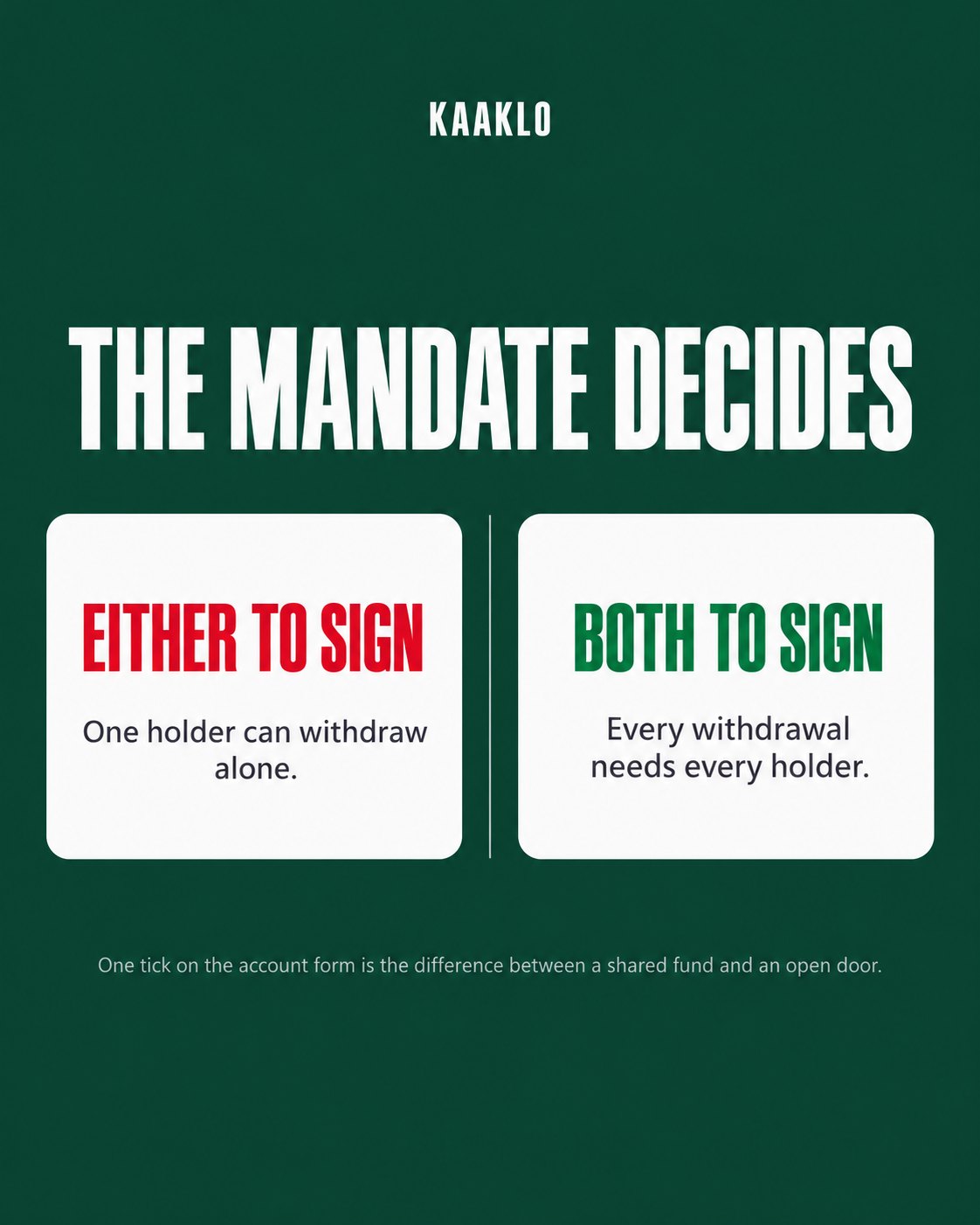
What decides day-to-day control is the mandate signed at opening. Either to sign means any one holder can withdraw alone. Both to sign means every withdrawal needs every holder. That one tick on a form is the difference between a shared fund and an open door [2][3].
With either to sign, the person at home can legally empty the account you filled. That is not theft in the bank's eyes. You authorised it.
Three risks worth pricing in
- Control. With an either-to-sign mandate, your co-holder can withdraw the whole balance without asking you. Most family arrangements run on trust. The ones that fail, fail here.
- Debt. A joint account can answer for one holder's judgment debt. In Meyiri Company Ltd v. SIC-Financial Services and Stanbic Ghana, the High Court allowed a joint account to be garnisheed [4]. Your building fund can end up paying someone else's loan.
- Death and dispute. Joint accounts are often payable to the survivor [2], which sounds simple. When a holder dies, family claims and customary disputes can freeze the money exactly when it is needed most. Get the survivorship terms in writing from the bank, not from a relative's memory.
The cleaner options
- Your own diaspora account. GCB's Link2Home, Zenith's diaspora account, UBA's Non-Resident Ghanaian account and Stanbic's diaspora banking all let Ghanaians abroad open and control an account from outside Ghana [5][6][7][8]. Your name, your control. You send what you choose, when you choose.
- Mobile money for the monthly float. Small, regular support moves fine through wallets, and the wallet limits naturally cap the damage when something goes wrong.
- Joint, but structured. If someone at home genuinely must hold the pen, split the money: a small either-to-sign account for monthly needs, and a both-to-sign account for the building fund that cannot move without you.
If you do open a joint account
- Decide the purpose first: emergency float or long-term fund. The mandate follows the purpose.
- Choose the mandate deliberately: both to sign for anything you cannot afford to lose.
- Register statements and SMS or email alerts to your own address. You cannot question a withdrawal you never saw.
- Put the family agreement in writing: what the money is for, and what needs your yes. Paper protects relationships; it does not replace them.
The bottom line
Sending money home is an act of trust. The mistake is letting the bank form make trust the only thing holding the arrangement. Love and paperwork are not opposites. The paperwork is how the love survives a bad month.
Sources and data note
Prepared 8 October 2026. This article describes general arrangements, not any one bank's contract. Mandate names and survivorship terms vary by bank; read the actual form before signing.
[1] RateWeb Ghana, joint bank accounts in Ghana explained - unity of interest
[2] GCB Bank, joint account opening form - payable to both, all, any, or the survivor(s)
[3] UBA Ghana, joint account booklet
[5] GCB Bank, Link2Home account
[6] Zenith Bank Ghana, diaspora account application
[7] UBA Ghana, diaspora banking - Non-Resident Ghanaian account